
Mannankulam Estate: A proven "Biodiversity Powerhouse”
Published on :
February 26, 2026
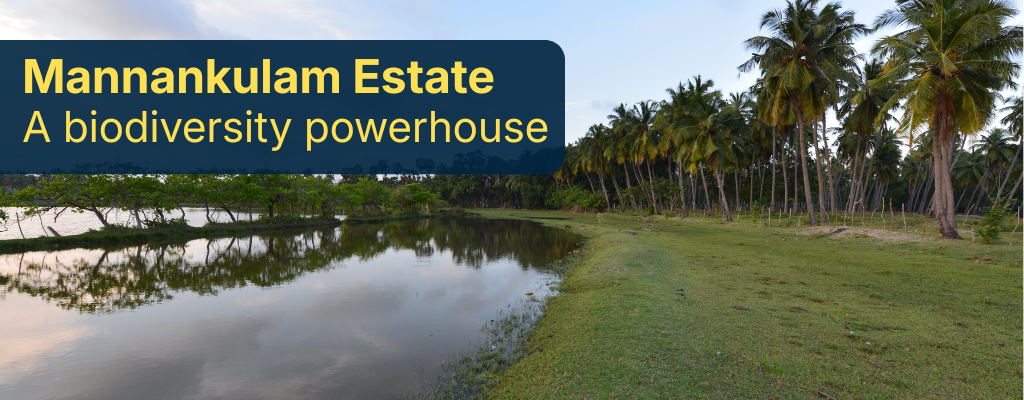
In a significant achievement for both our team and the scientific community, research scientist T. Shahirajh has published his three-year research study in the Ceylon Journal of Science. Co-authored with botanist Neela de Zoysa, the paper marks a milestone in documenting the biodiversity of our region
But this isn’t just an academic achievement. It is the scientific “Report Card” for Mannankulam Estate, proving that the way we are managing conservation and farming is actively saving Sri Lanka’s native species.
The Challenge: Farming in an Urban World
As cities expand, nature often loses. Mannankulam Estate sits within an urbanizing landscape on the Eastern Coast. The question Shahirajh set out to answer was: Can a working farm actually function as a nature reserve?
After three years of meticulous data collection (2021–2023), the answer is a resounding yes.
The Breakthrough Findings
The study revealed that our 12.5-hectare estate is a “biodiversity powerhouse.” Here is what the data showed:
- 227 Plant Species: We recorded a staggering variety of life across our coconut groves, rice fields, and lagoon edges.
- Native Pride: Over 78% of these plants are indigenous to Sri Lanka.
- A Sanctuary for the Rare: The estate is home to 17 Threatened and Near-Threatened species. This includes the endangered orchid Vanda tessellata and rare woody climbers that have disappeared elsewhere.
- A “Step-Stone” for Wildlife: By maintaining natural fences and lagoon edges, we provide a vital “rest stop” for birds and pollinators moving through the urban landscape.
The "Mannankulam Method"
How did we achieve this? The paper credits our Regenerative Farming practices. By moving away from heavy chemicals and monoculture, we’ve created a “mosaic” of habitats.
- Rotational Grazing: Our dairy cows help manage the land naturally.
- Heirloom Crops: Growing traditional rice varieties like Pachcha Perumal keeps the ecosystem balanced.
- Managed Edges: We leave “wild” spaces between our fields, allowing native shrubs and shade-tolerant plants to thrive.
Why This Matters to You
When you choose Mannankulam, you aren’t just supporting a local business; you are supporting a scientifically-proven conservation project. Shahirajh’s research proves that agriculture doesn’t have to destroy nature, it can be the very thing that protects it.
We invite you to read the full study and join us in celebrating this win for Sri Lankan biodiversity.
Reference: Shahirajh, T. & Zoysa, Neela. (2026). The floristic richness of a small agricultural holding in an urbanizing landscape: A case study of Mannankulam Estate, Eastern Coastal Sri Lanka. Ceylon Journal of Science. 55. 183-204. 10.4038/cjs.v55i1.8581.